
Your dog is thinking—just not in the language you use to wonder about it. In my exam room, I watch owners project full internal monologues onto their dogs, when what's actually happening is more immediate, more sensory, and often more survival-oriented than we imagine. Dogs think in pictures, smells, emotional associations, and action sequences. They're brilliant at pattern recognition, threat assessment, and reading your micro-expressions. They're not planning next Tuesday or wondering about mortality. They're here, now, processing whether that sound means walk or whether your posture means they're in trouble.
The body keeps the score. If you want to know what your dog is thinking, watch what they're doing with their whole animal—ears, tail, weight distribution, pupil dilation, the tiny freeze before the bark. Behavior is the only window we have, and it's a reliable one if you learn the grammar.
The Canine Mind: Sensory, Immediate, and Emotionally Fluent
Dogs don't think in sentences, but they absolutely experience mental states—anticipation, frustration, joy, fear, confusion, relief. What I see clinically is that dogs are constantly running a background threat-assessment program: Is this safe? Is this food? Is this play? Is this pain? Their brains are wired for survival first, social cohesion second, and everything else is negotiable.
According to research from the American Kennel Club, dogs process information through a combination of instinct, learned behavior, and emotional memory. They're exceptional at associative learning—if X happened last time, Y is probably coming. That's why your dog "knows" it's walk time before you've touched the leash. They've mapped your pre-walk routine down to the micro-gesture.
What they're not doing: feeling guilty for the chewed shoe (that's appeasement behavior in response to your anger), plotting revenge, or understanding why you're late. Time is elastic for dogs. They live in a continuous present tense, though they carry emotional memories that shape how they respond to new situations. Understanding dog body language is the fastest route to accurate translation.
What Breed Blueprint Tells You About Thought Patterns
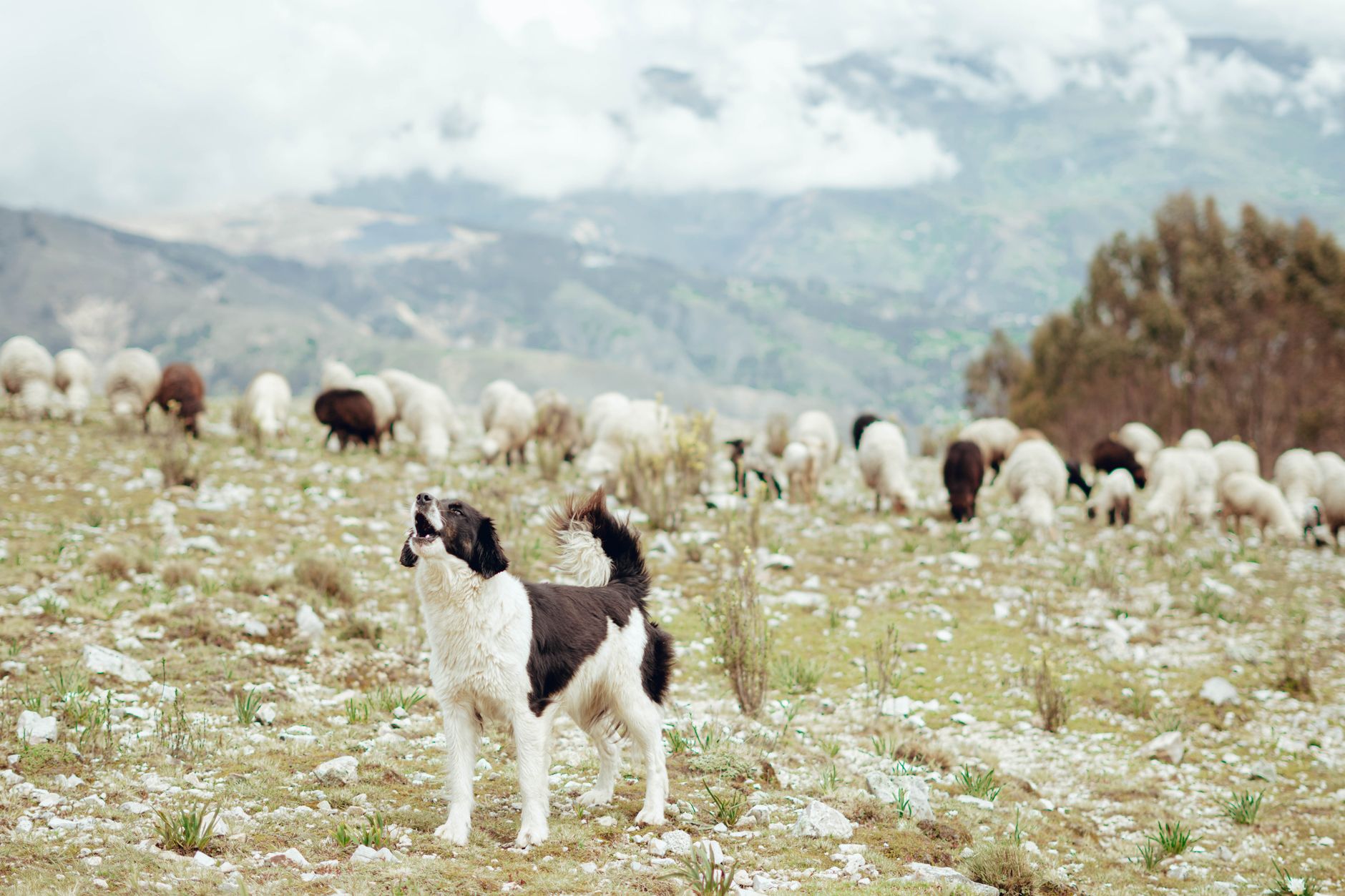
A Border Collie watching sheep isn't "thinking" the way you think about a spreadsheet—they're in a flow state, running ancient predatory sequences that stop just short of the kill. A Beagle who ignores your recall isn't being stubborn; their nose has hijacked executive function and they're following a scent story more compelling than your voice. Breed matters because it front-loads certain cognitive priorities.
Herding dogs think in motion and control. Hounds think in scent and chase. Terriers think in hunt-and-dispatch sequences. Retrievers think in cooperation and mouth-work. Guardian breeds think in threat-scan and territory. These aren't metaphors—they're nervous-system stuff, baked in by centuries of selection. Breed-specific behavior quirks aren't personality flaws; they're the factory settings.
In my exam room, I see a lot of frustration that dissolves once an owner understands their dog was literally bred to do the annoying thing. Your Husky isn't ignoring you out of spite—they're a independent problem-solver bred to make decisions on the fly in life-or-death terrain. Your Pointer isn't "obsessed" with birds; birds are the entire reason their ancestors were kept alive. Once you know the blueprint, behavior makes sense.
The Cosmic Layer: Personality Beyond Biology
Here's where it gets interesting. I'm a veterinarian, so I start with the body—but I've also seen enough to know that biology doesn't explain everything. Two Labradors from the same litter, raised in the same house, can have wildly different temperaments. One is a stoic, one is a neurotic. One loves every human, one is selectively social. The breed blueprint is there, but something else is shaping the individual.
That's where the cosmic layer comes in—not as woo, but as pattern recognition at a different scale. Astrology for dogs isn't about planets "causing" behavior; it's about noticing that dogs born under certain seasonal and celestial conditions tend to cluster around certain traits. A Scorpio dog (late October through late November) often shows intensity, loyalty, and a long memory for slights. A Gemini dog is usually social, distractible, and charming. These aren't absolutes, but they're frequent enough to be useful.
I think of it as another diagnostic lens. If behavior is biology until proven otherwise, sometimes the "otherwise" is a personality signature that astrology helps name. Your dog's birth chart won't tell you they have hip dysplasia, but it might tell you why they're more anxious than their littermate, or why they bond so intensely with one family member.
When "Thinking" Looks Like a Problem
Sometimes what looks like a thought problem is a body problem. The dog who suddenly "hates" the stairs might have arthritis. The dog who "ignores" commands might have hearing loss. The dog who's "spiteful" about house-training might have a UTI. I always, always rule out medical before I talk behavior, because pain changes everything.
That said—anxiety, compulsion, and fear are real mental states, and they're worth addressing as such. A dog who's thinking "threat, threat, threat" all day is suffering, whether the threat is real or not. Separation anxiety in dogs is a nervous-system fire, not a training failure. These are bodies talking, and sometimes they need medical intervention—behavioral meds, pain management, thyroid correction—not just more obedience drills.
If your dog's behavior has changed suddenly, or if they seem "stuck" in a loop (compulsive licking, pacing, barrier frustration), that's worth a conversation with your vet. The whole animal matters, and sometimes what looks like a mind problem has roots in the gut, the thyroid, or the pain pathways.
Reading the Room: What Your Dog Knows About You

Your dog is thinking about you more than you realize. They're tracking your facial expressions, your vocal pitch, your gait, your scent (which changes with stress, illness, and hormones). They know when you're anxious before you do. They know when you're sad. They adjust their behavior based on your emotional weather, which is why dogs mirror their owners' stress levels.
This is both beautiful and complicated. If you're tense on leash, your dog learns the world is dangerous. If you're calm, they borrow that calm. They're not mind-readers, but they're body-readers at a level that makes us look illiterate. In my exam room, I can often tell how a dog will behave by watching the owner walk in. The leash is a telephone line, and everything you feel travels down it.
So if you're asking what your dog is thinking, part of the answer is: they're thinking about what you're thinking. They're socially brilliant, and you're their primary attachment figure. You shape their inner world more than you know.
Ready to Hear What Your Dog Is Really Saying?
Behavior is biology, personality is pattern, and connection is cosmic. If you want to go deeper—past the breed blueprint and into the individual soul—Soul Chat is where we translate the whole animal. Not just what they're doing, but who they are beneath the doing. It's the conversation every dog owner wants but doesn't know how to start.
Sources
- American Kennel Club. "How Dogs Think." AKC Expert Advice. https://www.akc.org/expert-advice/lifestyle/how-dogs-think/
You can almost read their mind. See that personality turned into art — bright, characterful, unmistakably them.
>
Ready to read your dog's soul?
Written by Elena. Read your pet's cosmic chart →